Can Dogs Recognize Themselves in a Mirror? What Animal Studies Have Found
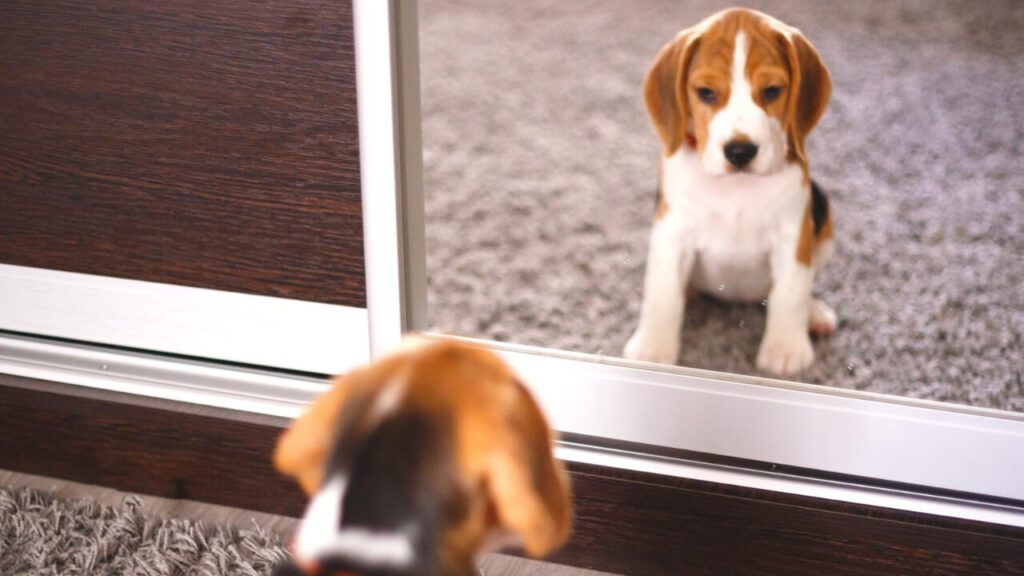
Place a dog in front of a mirror, and you might witness a rather entertaining encounter. Some dogs bark at their reflections. Others tilt their heads, approach cautiously, or search behind the glass for the mysterious animal staring back.
Then there are dogs that glance at the mirror and walk away, apparently unimpressed.
What’s actually happening inside their heads?
Scientists have spent decades investigating whether animals recognize themselves in mirrors. Dogs have consistently struggled with the traditional test, although research involving scent, body awareness, and problem-solving has revealed some fascinating abilities.
And I think the results expose a serious flaw in how humans judge animal intelligence.
Can Dogs Actually Recognize Their Own Reflection?
There is currently no convincing scientific evidence that dogs recognize their own reflection in the way humans and chimpanzees do.
Dogs haven’t demonstrated reliable success in the classic mirror self-recognition test, which looks for evidence that an animal understands the reflection represents its own body.
That finding answers a specific scientific question. It leaves several other questions about canine self-awareness open.
Researchers have identified three important distinctions:
- Visual self-recognition: Dogs haven’t convincingly demonstrated that they identify their reflection as themselves.
- Scent-based recognition: Dogs can distinguish their own odors from those of other dogs and respond to changes in familiar scents.
- Body awareness: Dogs show evidence of understanding how their bodies interact with physical obstacles.
These abilities involve different cognitive processes. Understanding them requires looking beyond the bathroom mirror.
The Mirror Test That Started Everything
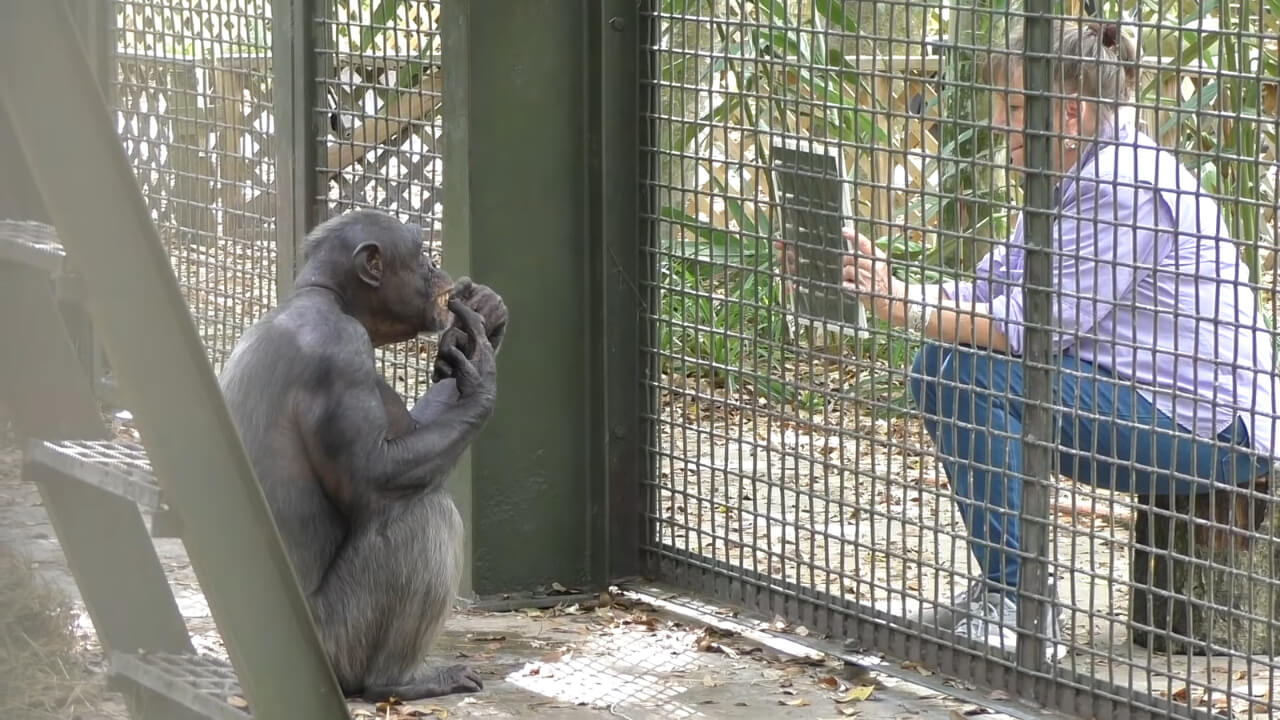
In 1970, psychologist Gordon Gallup Jr. published a groundbreaking study involving chimpanzees in the journal Science.
His experiment introduced what became known as the mirror self-recognition test, or mark test.
The basic procedure works like this:
- An animal becomes familiar with a mirror.
- Researchers discreetly place a visible mark somewhere on its body, usually where it cannot see the mark directly.
- The animal receives access to the mirror again.
- Researchers observe whether it uses the reflection to investigate the mark on its own body.
Imagine discovering an unexpected red spot on your forehead while looking in the mirror. You would probably reach toward your forehead.
Chimpanzees demonstrated comparable mark-directed behavior, providing evidence that they understood the relationship between the reflection and their own bodies.
Subsequent studies have reported mirror-related self-examination in dolphins, elephants, and certain birds, although some interpretations remain disputed.
Dogs have never demonstrated similarly convincing performance in the traditional test.
My biggest objection comes when people turn that result into an intelligence ranking.
The mirror test measures a particular ability under particular conditions. Treating it as a universal measure of animal intelligence is scientifically indefensible.
What Dogs Really Do When They See Themselves
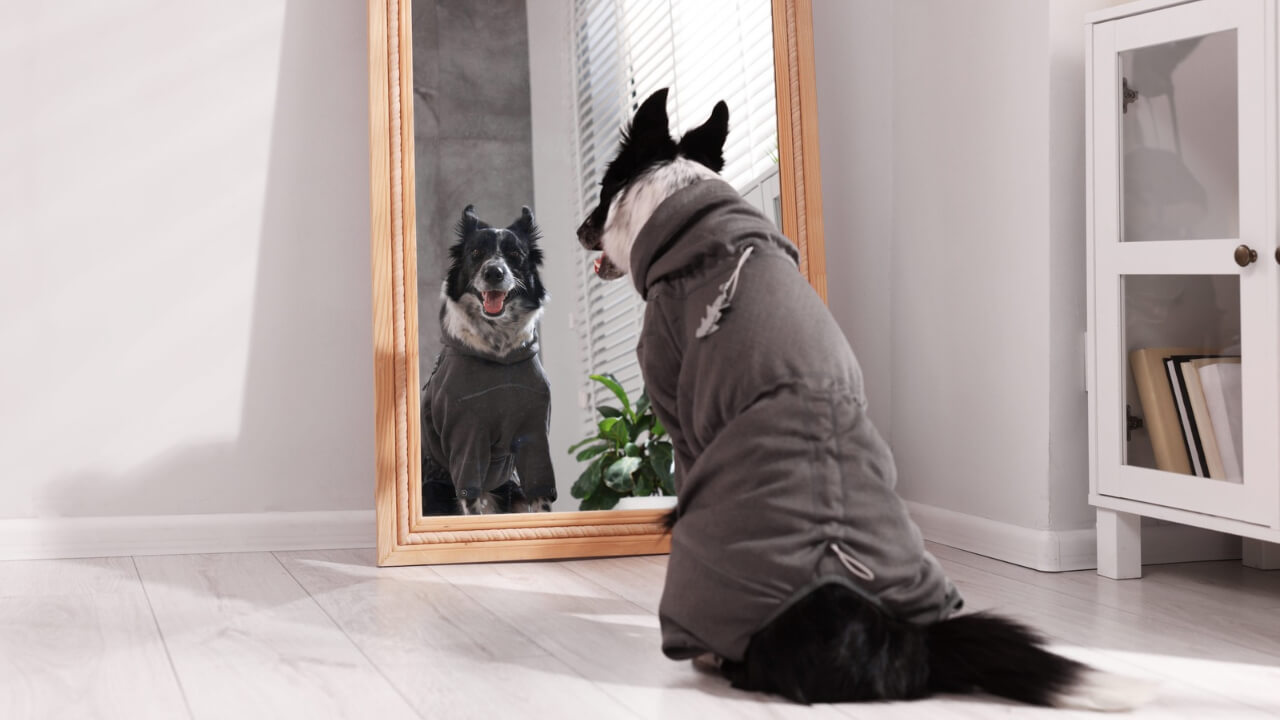
A dog’s first encounter with a mirror can look remarkably similar to meeting an unfamiliar dog.
You might notice:
- Barking, growling, or playful movements toward the reflection.
- Sniffing the glass or checking behind the mirror.
- Watching the reflection briefly before losing interest.
- Ignoring the mirror entirely.
These behaviors vary between individuals and with previous exposure.
Dogs frequently become accustomed to mirrors over time. The reflection stops being interesting, and they return to whatever they were doing.
However, losing interest in a reflection doesn’t establish self-recognition.
A dog might simply learn that the strange animal in the glass never produces the sounds, smells, or independent movements expected from another dog.
Researchers have also examined whether dogs can use mirrors to locate objects.
In a 2011 study of 40 dogs, Tiffani Howell and Pauleen Bennett investigated whether dogs could identify the actual location of a person visible through a mirror.
Only two dogs displayed responses that researchers considered potentially consistent with understanding the reflection’s location. Even those responses were ambiguous.
Other experiments have suggested that some dogs can learn to use mirrors as problem-solving tools.
Recognizing where a reflected object is located requires a different ability from recognizing your own reflected body.
That distinction matters enormously.
The 2017 Study That Gave Dogs an Olfactory Mirror
View this post on Instagram
Here’s where the research becomes genuinely exciting.
Dogs experience much of their environment through smell. Their noses help them investigate other animals, familiar places, and countless changes that humans would never notice.
So why should a visual mirror be the definitive test of canine self-recognition?
Psychologist Alexandra Horowitz explored this question in a 2017 study published in Behavioural Processes.
She developed an experiment involving what she called an olfactory mirror.
Instead of asking dogs to examine their reflections, she presented scent samples in containers.
The first experiment involved 36 dogs and included samples of their own urine, urine from other dogs, and their own urine modified with an additional odor.
The findings were intriguing.
Dogs spent longer investigating their own scent when researchers had altered it.
They also generally investigated other dogs’ urine longer than their own familiar urine.
A second experiment helped establish that interest in the added odor alone couldn’t fully explain the modified-scent response.
Horowitz suggested that dogs might possess a form of olfactory self-recognition.
I consider this one of the most valuable approaches to studying canine identity. It starts with how dogs naturally investigate their surroundings.
Does That Prove Dogs Are Self-Aware?
The evidence still requires careful interpretation.
In a subsequent scientific critique, researchers Gordon Gallup and James Anderson questioned whether the olfactory findings established genuine self-recognition.
A dog might distinguish familiar from unfamiliar odors without possessing an understanding of itself comparable to that demonstrated in the mirror-mark test.
That’s a legitimate concern.
I strongly support experiments designed around animals’ natural senses. I also think declaring a complicated psychological question settled after one promising study is irresponsible.
Recognizing your own smell and possessing a conscious concept of yourself are separate scientific claims.
Horowitz’s experiment provides important evidence about canine scent discrimination. The broader question of self-awareness remains unsettled.
Dogs Know When Their Own Bodies Are Getting in the Way
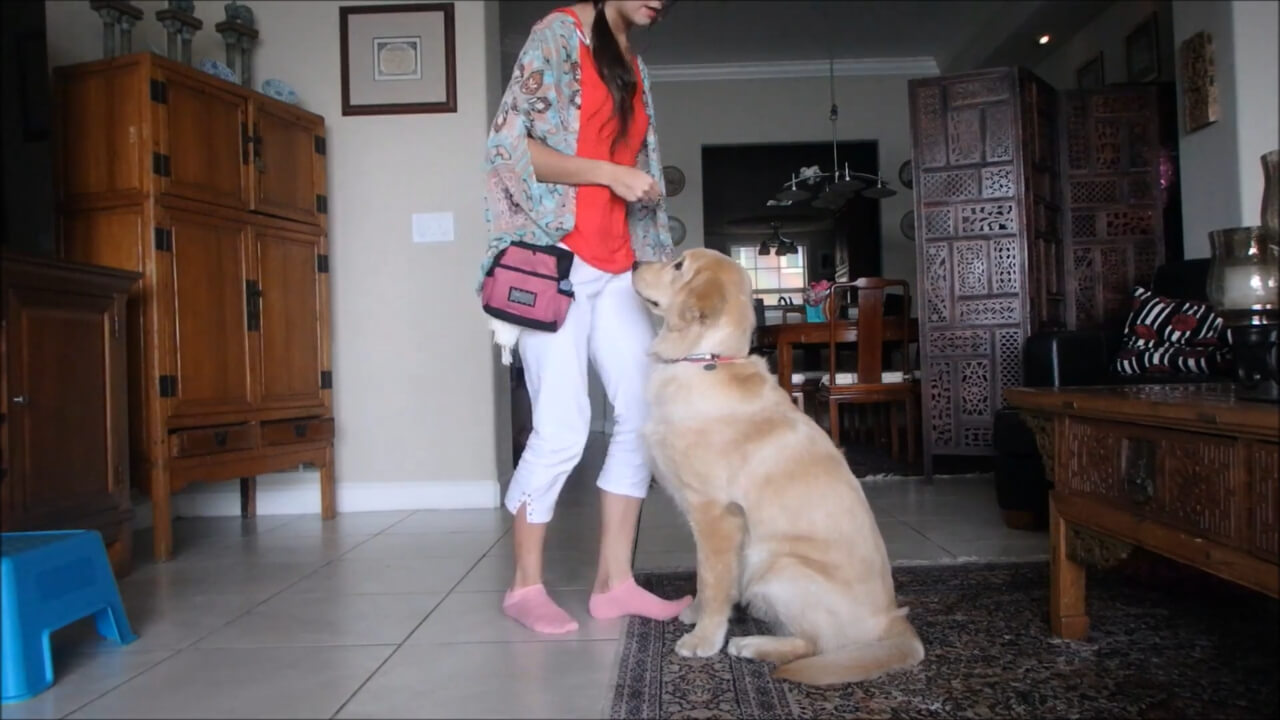
One of the strongest arguments for canine body awareness comes from an experiment that didn’t require a mirror at all.
In 2021, researchers published a study in Scientific Reports involving 32 dogs. The setup was wonderfully straightforward.
Dogs stood on a mat while their owners asked them to pick up and hand over an object. During the critical condition, the object was attached to the mat beneath the dog’s feet.
To successfully lift it, the dog needed to step off the mat.
The researchers also included control conditions designed to distinguish awareness of the dog’s own body from reactions to a stuck object or movement beneath its feet.
The results were striking. In the first trials, 27 of the 32 dogs stepped off the mat when their bodies were obstructing the task. In the relevant control condition, 14 did so.
Dogs also moved off the mat more quickly when their own bodies were responsible for the obstruction.
The researchers interpreted this as evidence that dogs could recognize their bodies as physical obstacles.
I find this experiment especially compelling because it examines awareness through an ordinary physical problem.
Another Study Found Dogs Understand Their Own Size
In 2023, researchers tested 68 family dogs in another body-awareness experiment.
The dogs needed to reach food behind a barrier.
Sometimes a large opening provided a shortcut. Other times, the available opening was too small, making a longer route the sensible choice.
Dogs generally selected the shortcut when the opening was large enough and took the detour when it was too small.
Their decisions suggested an understanding of their own body dimensions.
Together, these studies provide meaningful evidence of physical self-representation in dogs.
They still cannot establish whether dogs experience a reflective sense of personal identity.
What Different Animal Studies Actually Tell Us
The research becomes easier to understand when we separate the questions being tested.
| Research approach | What scientists found |
| Classic mirror test | No convincing visual self-recognition demonstrated in dogs |
| Olfactory mirror test | Dogs investigate their own modified scent longer |
| Body-as-obstacle experiment | Dogs adjust their position when their body prevents an action |
| Body-size experiments | Dogs make decisions based on whether their bodies can fit through openings |
The most important lesson is that self-awareness includes several potentially distinct abilities.
A dog can demonstrate sensitivity to its own body and familiar scent without necessarily possessing the kind of self-reflective awareness humans describe.
Understanding those distinctions makes the science considerably more useful.
Why Humans Keep Misunderstanding Animal Intelligence
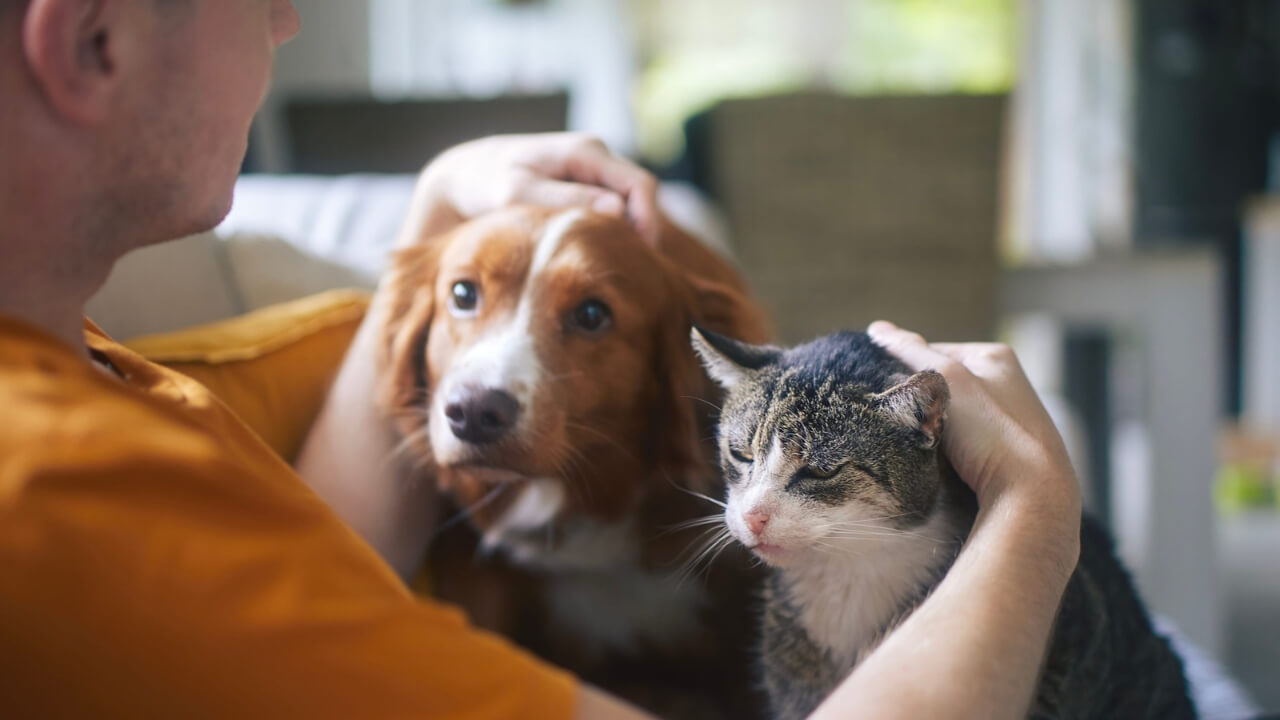
I’ve always found it frustrating when people assume an animal lacks understanding simply because it fails to respond as expected.
The same mistake appears in everyday pet ownership. Someone calls a cat, receives no response, and concludes that the animal doesn’t recognize its name.
Yet research into whether cats recognize their own names demonstrates how misleading that assumption can be.
Recognition and observable behavior are separate things.
Mirror experiments raise similar challenges.
Dogs rely heavily on scent. Cats may communicate their attention through subtle movements. Different species have evolved different ways of processing information.
I think scientists should be particularly careful when designing experiments around human expectations.
And pet owners should be even more careful about turning those experiments into sweeping judgments about their animals.
An animal’s abilities deserve to be studied in the context of its own biology.
Should You Test Your Dog With a Mirror at Home?
There’s nothing wrong with observing how your dog responds to a mirror, provided the experience remains comfortable.
Just remember that your living room isn’t a controlled laboratory.
If you’re curious, try this:
- Allow a natural encounter. Let your dog approach a safely positioned mirror voluntarily.
- Watch the whole body. Notice posture, tail movement, facial tension, and willingness to approach.
- Observe changes over time. Does the dog gradually lose interest after repeated exposure?
- Respect signs of discomfort. If your dog becomes frightened or persistently agitated, remove access to the reflection.
Avoid deliberately frightening your dog or forcing repeated encounters.
If you want to reward calm behavior around a mirror, use praise or a small, appropriate treat. Familiar foods such as plain, properly prepared turkey can be suitable occasional rewards.
And please don’t interpret your dog’s reactions as proof of self-recognition.
Barking at a reflection, inspecting the glass, or eventually ignoring it cannot establish what your dog understands about its own identity.
A home observation can be interesting without becoming a scientific experiment.
So, Do Dogs Have a Sense of Self?
I think the evidence gives us plenty of reasons to take canine self-awareness seriously.
Dogs haven’t demonstrated convincing visual self-recognition. They have shown meaningful abilities involving their own scent, body position, and physical dimensions.
Those findings deserve attention.
What I reject completely is the idea that a dog’s failure to recognize its reflection makes it intellectually inferior.
A mirror reveals one narrow part of an animal’s cognitive world. Researchers are developing better ways to investigate the rest.
For anyone fascinated by these questions, our pet care and behavior articles explore more of the surprising ways animals experience everyday life.
And the next time your dog walks past a mirror without a second glance, I wouldn’t worry about what it says about their intelligence.
There is an entire world of information waiting for them at nose level.